Richmond C-PACE Program Aims to Encourage Clean Energy Updates
Richmond property owners rehabbing or developing commercial properties soon will have a new financial incentive to include clean energy and...
Read More
Program Status
Several localities across the Commonwealth have established or are currently developing C-PACE programs.
| Locality | Status |
|---|---|
| Statewide Program | Active; launched September 2022; program administrator: Virginia PACE Authority |
| Albemarle County | Ordinance passed in January 2023 to join the statewide program |
| Arlington County | Active; launched in January 2018; program administrator: Sustainable Real Estate Solutions |
| Chesterfield County | Ordinance passed in February 2024 to join the Statewide Program |
| City of Alexandria | Active; launched in September 2021; program administrator: Virginia PACE Authority |
| City of Chesapeake | Ordinance initially passed in February 2022; ordinance to join the Statewide Program passed in 2023 |
| City of Danville | Ordinance passed in January 2020 |
| City of Fredericksburg | Active; launched in December 2018; program administrator: Virginia PACE Authority |
| City of Harrisonburg | Ordinance passed in October 2023 to join the Statewide Program |
| City of Hopewell | Ordinance passed in April 2023 to join the Statewide Program |
| City of Lynchburg | Ordinance enacted; ordinance passed in December 2019 |
| City of Martinsville | Ordinance passed in Q1 2024 to join the Statewide Program |
| City of Norfolk | Active; program administrator: Virginia PACE Authority |
| City of Petersburg | Ordinance initially passed in July 2019; ordinance passed to join the Statewide Program in Dec 2023 |
| City of Richmond | Ordinance to join the Statewide Program passed in Sept 2023 |
| City of Roanoke | Active; program administrator: Virginia PACE; ordinance passed in October 2020 Authority |
| City of Virginia Beach | Ordinance to join the Statewide Program passed in February 2023 |
| City of Winchester | Active; Ordinance to join Statewide Program passed in April 2024 |
| Fairfax County | Active; Ordinance to join Statewide Program passed in June 2023 |
| Henrico County | Ordinance passed in August 2023 to join the Statewide Program |
| Loudoun County | Active; originally launched in November 2019; passed ordinance in early 2023 to join the Statewide Program |
| Louisa County | Active; program administrator: Virginia PACE Authority; ordinance passed June 2021 |
| Prince William County | Ordinance passed April 2023 to join the Statewide Program |
| Rockingham County | Ordinance passed in July 2024 to join the Statewide Program |
| Shenandoah County | Ordinance passed in 2023 to join the Statewide Program |
| Town of Dumfries | Active; launched in September 2020; program administrator: Virginia PACE Authority |
| Wise County | Ordinance passed January 2022 |
Projects Closed
| Locality | Amount Financed | Date Closed | Project Type |
|---|---|---|---|
| Arlington County | $142k | 2021 | Restaurant |
| Prince William County | $8.7M | December 2023 | Senior Living Facility |
| City of Petersburg | $2.64M | December 2023 | Hotel |
Enabling Legislation

C-PACE finances clean energy and resiliency renovations for commercial and multifamily buildings.
Virginia joined more than 36 states and the District of Columbia in adopting C-PACE legislation in 2009 and adopting amendments in 2015. It is up to each locality to pass a C-PACE ordinance if they would like to offer a program.
The 2020 General Assembly passed legislation allowing Virginia to offer a statewide C-PACE program. The program launched in September 2022 and is now active and open to localities wishing to participate. The Virginia PACE Authority (VPA) is administering the program for the state energy office (Virginia Energy).
The statewide program reduces the time, costs, and administrative hurdles for jurisdictions interested in offering C-PACE by eliminating the need for a locality to create its own program. For those who already offer a C-PACE program, a simple documentation upgrade is all that is needed to join the statewide program. Learn more about the statewide C-PACE program by visiting the VPA and Virginia Energy websites.
The VAEEC is committed to accelerating the implementation and utilization of C-PACE throughout Virginia. Combining efforts with other stakeholders, we are working to facilitate interest in C-PACE by building a coalition of supporters and engaging with localities. We continue to be a neutral, trusted resource on C-PACE and are actively meeting with local governments across Virginia to discuss all available options and help each locality determine which option best suits their needs.
A partnership between VA, D.C., and MD to advance C-PACE financing throughout the region
In 2017, the VAEEC joined the Mid-Atlantic PACE Alliance (MAPA), which is comprised of state agencies, non-profit institutions, and private businesses working to accelerate the development and utilization of C-PACE in Virginia, Maryland, and DC. This effort promotes the collaboration among local and state governments, capital providers, C-PACE program administrators, energy service contractors, and building owners to create low-cost, standardized guidelines that will enhance financing efficiency and increase the volume of C-PACE projects. The goal is to achieve consistency and growth in C-PACE programs within the tri-state area.
This is an exciting time for C-PACE in Virginia, as more and more options and resources are becoming available for localities. The VAEEC believes that having a variety of C-PACE program options is crucial to accelerating the number of and demand for C-PACE programs in Virginia. By increasing the number of options available, localities are more likely to find a program administrative model that fits their goals and needs.
GIS Maps
In 2019 the VAEEC created several maps of C-PACE eligible buildings in key localities across the Commonwealth. The maps help visualize the supply of C-PACE eligible buildings within these localities while also demonstrating the potential demand for C-PACE. For more information or to view the maps, click here.
Virginia Model Ordinance
In early 2018, the VAEEC released a Virginia model ordinance for localities to use when crafting their own program. The ordinance was commissioned following review and input from a wide variety of C-PACE experts in the lending, local government, engineering, legal, and policy fields. This document incorporates key factors that we consider to be crucial to implementing an effective C-PACE program. The VAEEC’s Virginia model ordinance can be downloaded here. An abbreviated ordinance was created by the Virginia PACE Authority (VPA) using this ordinance as their template. The VPA ordinance can be viewed here.
MAPA Implementation Toolkit
As part of its mission to accelerate the development and utilization of C-PACE in the Mid-Atlantic region, MAPA has created program implementation guidance. The toolkit is a resource for stakeholders, including but not limited to local governments, program administrators, building owners, contractors, capital providers, and local lenders, providing best practices specific to this region. For localities, the provided guidance and resources streamline efforts to develop and launch a C-PACE program. The regional toolkit can be viewed on the MAPA website.
RFP Template
An RFP template has been created for localities to use when crafting a Request for Proposals for Program Administrator services.
Cooperative Procurement
Under Virginia law, localities can rely on another locality’s procurement process, so long as the prior locality’s ordinance specifically allows other localities to do so, which eliminates the need for a locality to go through their own RFP process to hire a third-party administrator. Some early adopters of C-PACE have added this provision to their ordinances.
Letter of Support Templates
Over the past few years, the VAEEC has seen how constituent support and outreach play a critical role in getting localities to move forward with developing a program. If you are interested in C-PACE and would like to contact your local government officials to urge them to launch a program, the VAEEC has created template letters to help you craft your message.
U.S. Department of Energy’s C-PACE Toolkit
The U.S. Department of Energy’s State & Local Solutions Center created a C-PACE toolkit, a four-part compilation of resources to navigate the barriers and benefits from C-PACE. This resource includes best practices and innovative approaches, how to implement a program and generate project uptake, and using C-PACE to support underserved communities or advance resilience objectives.
C-PACE is an innovative way to finance clean energy and resiliency projects on commercial, multifamily, and nonprofit buildings (excluding multifamily properties with less than five dwellings). The loans are designed to be long-term (up to 20+ years) secured by a lien that has a priority status equal to a tax assessment, thus senior to a mortgage lien. By setting up a C-PACE program, a locality can enable private sector loans for 100% of total project costs by placing a special assessment lien on the property that the owner repays over time as part of his/her tax or utility bill.
To learn more about C-PACE, check out the Mid-Atlantic PACE Alliance’s resources page for fact sheets, FAQs, case studies, and more.
Additional resources
View our C-PACE recommendations in our report: Why Energy Efficiency is a Smart Investment for Virginia
Read our letter to the City of Richmond’s City Council regarding their C-PACE ordinance here.
December 2019 Webinar: The Evolution of C-PACE in the Mid-Atlantic
September 2018 Webinar: C-PACE in Virginia- Resources Available to Localities
September 2017 Webinar: Commercial PACE Financing in Virginia
October 2016 Webinar: PACE in Virginia


Nov 19
Sep 19
Jun 19
By now, many of you have probably heard us speak about commercial Property Assessed Clean Energy, or PACE, financing. It has become one of VAEEC’s top focuses in the past few years due to its ability to spur economic growth and revitalization while also reducing energy usage in commercial buildings. To learn more about the basics of PACE, visit our PACE webpage.
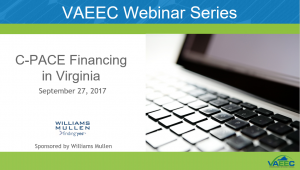
Recently, VAEEC held our second PACE webinar, C-PACE Financing in Virginia, back in September. Unlike our first PACE webinar, which mainly covered the basics of PACE, the main goal of this webinar was to be a resource for localities interested in developing and implementing a PACE program. The webinar provided listeners with:
PACE provides financing for energy efficiency renovations for commercial and multifamily buildings.
William Nusbaum (Williams Mullen) kicked things off with an overview of what PACE is and how it works in Virginia. He also touched on the Mid-Atlantic PACE Alliance, or MAPA, which is a partnership between Virginia, Maryland, and DC stakeholders created to accelerate PACE programs and project closings in the region.
Time and resources are by far the two most common concerns we hear from localities when talking about developing a PACE program. Scott Dicke (Sustainable Real Estate Solutions (SRS) and Arlington C-PACE) was able to address these concerns by discussing the role of the PACE program administrator. Program administrators alleviate the burdens placed on a locality when starting up and running a PACE program. They provide contractor education and support services to contractors, building owners, capital providers, and localities. Scott reinforced these points by providing case studies of programs SRS has helped launch and run.
Susan Elliott (City of Charlottesville) closed out the webinar with a local government perspective. Localities are interested in PACE because it is a tool that helps spur economic develop and revitalize existing building stock. Furthermore, Susan dove into the internal process of developing a PACE program and spoke about existing resources that help localities each step of the way.
Presentation slides and the audio recording can be accessed here. If you have any questions or if you would like additional information about PACE, please contact Jessica Greene.
A special thank you to Williams Mullen, our webinar sponsor, and our speakers.
Property Assessed Clean Energy financing, or PACE, is starting to get more and more attention around the Commonwealth and the nation. In fact, Governor McAuliffe and his administration recognized PACE as a viable means to create more jobs, save energy, and lower electricity bills in a recent press release. As it’s popularity increases, many are still unaware of just exactly what PACE is and who it can benefit.
PACE financing is a loan program to help bring low-cost, long-term capital to fund the rehabilitation of existing and new privately owned commercial buildings through energy efficiency, renewable energy, and water conservation projects. The loan is repaid annually through the property’s real estate tax bill.
Thirty-three states and Washington, D.C. have passed legislation at the state level to enable PACE financing; nineteen of those states have already started a PACE program. In Virginia, a commercial PACE, or C-PACE, enabling law was originally enacted in 2009 and amended in 2015. Virginia’s PACE law requires a locality to develop a PACE program, and private lenders make the loan and negotiate directly with the property owner on rates and terms. Currently, Arlington County is the only Virginia jurisdiction actively developing a PACE program; however, several over localities are exploring the development of their own programs.
Practically all privately-owned commercial buildings, regardless of size, are eligible for PACE financing, including office, retail, hotel, and industrial space. Eligible PACE projects must either reduce energy consumption or generate energy, and they must be permanently affixed to the property. Eligible improvements include: insulation, solar panels, lighting, roofing, and HVAC systems. In Virginia, commercial, nonprofit, and multifamily buildings (except condos and dwellings with less than five units) are eligible regardless of their age.
PACE offers an array of benefits for each key stakeholder: property owner, contractor, lender, locality.
Property owners:
– 100% financing: PACE covers 100% of all hard and soft project costs, eliminating the need for upfront cash investment.
– Long-term loan: With terms up to 20+ years, PACE loans result in lower annual payments and immediate positive cash flow.
– Transferable: PACE loans do not have to be paid off at the time of sale; they transfer to the new owner.
– Non-accelerating loan
Contractors:
– Increase sales volume and improve profit margin: By covering 100% of project costs and eliminating the requirement for out-of-pocket expense, PACE brings financing to more customers. Since PACE is based on equity in the property and not personal credit, it is easier for more customers to obtain financing.
– Fund deeper energy retrofits: Long-term financing enables customers to take advantage of projects with longer paybacks, which leads to more comprehensive projects with greater effect on energy usage. PACE can also fund efficiency improvements that are not allowable uses of Weatherization Assistance Program funds (i.e. replacement windows).
– Gain support and resources: PACE programs can be developed to offer an array of contractor services to help grow business and streamline financing. Services include training, call center support, customizable marketing materials, tools to pre-qualify customers, project estimation calculators, and web portals for financial analysis and deal-tracking.
– Spur demand for retrofits and energy auditors: As the number of people taking advantage of PACE increases, PACE could spur a surge of private demand for well-trained retrofitters. Additionally, as the program grows, so will the demand for energy audits. Energy audits are used to track a building’s energy usage before and after PACE improvements are installed.
Lenders:
– Meet client’s needs of implementing upgrades
– Increase value of collateral: upgrades and improvements increases the value of the property
– Enhances property owner’s ability to pay their debt: raises net operating income (NOI) through low annual payments and decreased operating costs
Localities:
– Creates employment opportunities for contractors, trades, engineers, vendors, etc.
– Serves as a redevelopment tool for “tired” buildings with obsolescent and inefficient systems
– Improvements make buildings more marketable, leading to better tenant retention and increases property values
– Increased property taxes and construction fees yields more revenues for jurisdictions
– Reduces locality’s carbon footprint, enabling it to become a green leader
– Minimal municipal burden: a third party administrator carries the cost of starting and running the program
The difference between traditional bank financing and PACE financing:
| Traditional Bank Financing | PACE Financing |
| Purpose: HVAC and Lighting | Purpose: HVAC and Lighting |
| Project Cost: $100,000 | Project Cost: $100,000 |
| Loan: $75,000
25% upfront cash investment required |
Loan: $100,000
$0 upfront cash investment required |
| Interest Rate: 5% | Interest Rate: 6.25% |
| Term: 5 years, fully amortizing | Term: 15 years, fully amortizing |
| Monthly Payment: $1,415 | Monthly Payment: $857 |
| Annual Payment: $16,984 | Annual Payment: $10,290 |
PACE financing is a lucrative tool that can benefit all parties involved. We look forward to seeing Arlington get their program up and running later this year and are excited to continue working with other localities as they explore the feasibility of developing their own PACE programs.
If you would like additional information about PACE, please contact VAEEC Program Coordinator Jessica Greene.
Last week (February 20, 2017) VAEEC participated in the first Mid-Atlantic PACE Alliance (MAPA) kick-off meeting in northern Virginia. MAPA is the result of a U.S. Department of Energy grant to support the development, implementation, and utilization of Commercial Property Assessed Clean Energy (C-PACE) programs throughout Virginia, Maryland, and Washington, D.C. The Virginia Department of Mines, Minerals and Energy is leading this effort between private and public stakeholders to develop and promote best practices, which will make the development of PACE programs more effective and will accelerate the growth of C-PACE programs throughout the region.
Educating stakeholders and standardizing templates and models are two key focuses of the MAPA team. Partners will use grant money to educate primary stakeholders (localities, property owners, lenders and borrowers, and contractors) about PACE. The second focus is to develop streamlined, consistent practices that will propel the adoption of PACE across Virginia while supporting the expansion of existing programs in Maryland and Washington, D.C. This includes the creation of consistent, cost-effective practices for program administration, drafting ordinances, financial underwriting guidelines, measurement and verification requirements, contractor training, and overall support.
This grant will enhance the work the VAEEC is already doing to further promote and advance PACE throughout the Commonwealth.
Click here to learn more about MAPA and here to read a copy of Governor McAuliffe’s press release about the grant.
The Virginia Energy Efficiency Council is diligently working to build a coalition of support for Property Assessed Clean Energy financing, or PACE, and to provide guidance and resources to localities interested in developing PACE programs. To assist with this effort, VAEEC has initiated a series of events across the Commonwealth suitably called “PACE Lunch + Learns”. Each event is open to anyone interested in learning more about PACE; however, these events target commercial property owners, contractors, lenders, and local government officials. Knowledgeable speakers from the field will provide attendees with information on PACE and answer PACE-related questions. VAEEC is teaming up with different sponsors to host the events and provide a complimentary lunch to all in attendance.
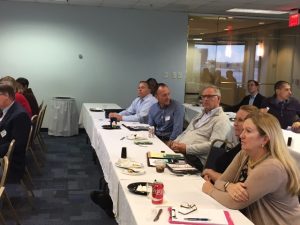
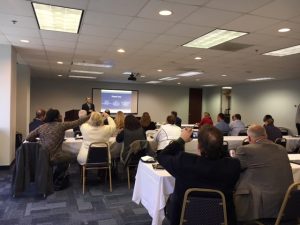
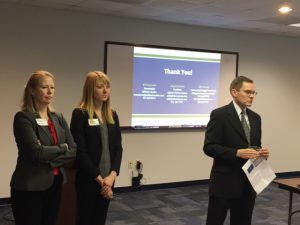
On Monday, December 5, VAEEC and Williams Mullen kicked off the first Lunch + Learn for the Hampton Roads/Norfolk area with a diverse group of nearly 30 people in attendance. Speakers included Abby Johnson, Bill Nusbaum, and Rich Dooley. Abby Johnson is the President and founder of Abacus Property Solutions, an independent real estate advisory firm. Abacus provides PACE project development and consulting and works with capital partners to identify PACE opportunities and develop PACE programs. Bill Nusbaum is an attorney with Williams Mullen, a full-service law firm, which is a key stakeholder in developing PACE financial underwriting guidelines with the Department of Mines, Minerals and Energy along with Abacus and VAEEC. Rich Dooley is the Community Energy Coordinator with Arlington Initiative to Rethink Energy (AIRE) in Arlington County. AIRE’s goal is to cut greenhouse gas emissions from County operations. Arlington County is the first locality in the Commonwealth on track to develop a PACE program.
The presentation provided a wealth of knowledge for all in attendance as it covered many different aspects of PACE. Here are my key take-aways:
Our next PACE Lunch + Learn is scheduled for Tuesday, January 31 in Ashland. Stay tuned for a Lunch + Learn event in your area.

Last week (September 26, 2016) I started my new position of Program Coordinator with Virginia Energy Efficiency Council, where a large portion of my job is dedicated to building coalitions of PACE (Property Assessed Clean Energy financing) supporters throughout the Commonwealth. Being relatively new to the world of PACE, I immediately immersed myself in PACE research. Therefore, imagine my excitement when I learned VAEEC was kicking off their webinar series with a “PACE in Virginia” webinar!
The webinar promised an overview of PACE financing, including benefits to contractors and property owners, case studies, and a breakdown of what PACE looks like in Virginia, presented by three speakers with amply knowledge and experience in the field. And it delivered.
I found the webinar to be incredibly beneficial. Elyssa Rothe’s (PACENation) overview reinforced the basics of PACE, which provided good background knowledge for the rest of the presentation. Abigail Johnson (Abacus Property Solutions) dove further into the benefits of PACE and provided two case studies as examples. Bill Greenleaf (Virginia Community Capital) ended the webinar with a summary of what PACE looks like in Virginia.
Here are my greatest take-aways from the webinar:
If you were unable to attend the webinar, I urge you watch our “PACE in Virginia” webinar recording. Even if you already have a good understanding of PACE, this webinar will serve as a great refresher as you listen to experts well entrenched in the field.
Please note that we also have a PACE page on our website with updates and resources.
Since our last post about PACE (Property Assessed Clean Energy) in Virginia, we continue to move the needle forward on PACE financing in our state. In early April, Virginia Community Capital released the final recommendations from our Oak Hill Fund grant.
Although we concluded that a statewide program administrator would be the ideal solution to ensure rapid advancement of PACE in Virginia, we also concluded that there is no known existing funding to support the creation of statewide program administrator. However, Abacus Property Solutions assisted the Virginia Department of Mines, Minerals and Energy (DMME) in responding to a Department of Energy State Energy Program (SEP) grant that, if awarded, would provide Virginia and partner states, Maryland and District of Columbia, with $500,000 in PACE funding across our region. This three-year grant would help seed and develop statewide PACE efforts including:
 If awarded, the DOE grant would address specifically administrative structure, owner eligibility, financial underwriting guidelines, energy audit and measurement & verification requirements, contractor training and support, capital provider support, and marketing messages and strategy. The VAEEC would receive a portion of this funding from this DOE/DMME grant to implement some of the work in the grant.
We feel that our response was strong due to our regional approach across three states and the problem that we are solving with a standardized model. DMME should know by late August or early September 2016 if we were awarded the grant, with funding provided by mid fall.
In the interim, the grant recommendations included the notion that VAEEC develop a comprehensive local government and energy contractor PACE education and outreach effort and offer technical assistance to local governments interested in PACE. An additional recommended task is to build grassroots efforts to compel localities to create PACE programs. The VAEEC is well positioned to build a grassroots campaign of energy service companies, clean energy advocates and property owners in local jurisdictions.
In late February, Arlington County issued a RFP to select a third party PACE program administrator. The creation of a PACE program in Arlington with a third party administrator creates another path forward to advance PACE in Virginia. Other localities can replicate the Arlington model, which calls for a third party to run their program and be paid from origination fees.
Finally, in late March 2016, the Richmond City Council passed a resolution calling for the Chief Administrative Officer to submit a proposal to City Council by January 31, 2017, with recommendations for creating a PACE program. The city is now forming a PACE stakeholder group and will study the Arlington model as part of its work plan to develop recommendations for implementing a PACE program.
Guest Blogger: Abby Johnson, Abacus Property Solutions (VAEEC Member – Individual)
