Several localities across the Commonwealth have established or are currently developing C-PACE programs.
Locality
Status
Statewide Program
Active; launched September 2022; program administrator: Virginia PACE Authority
Albemarle County
Ordinance passed in January 2023 to join the statewide program
Arlington County
Active; launched in January 2018; program administrator: Sustainable Real Estate Solutions
Chesterfield County
Ordinance passed in February 2024 to join the Statewide Program
City of Alexandria
Active; launched in September 2021; program administrator: Virginia PACE Authority
City of Chesapeake
Ordinance initially passed in February 2022; ordinance to join the Statewide Program passed in 2023
City of Danville
Ordinance passed in January 2020
City of Fredericksburg
Active; launched in December 2018; program administrator: Virginia PACE Authority
City of Harrisonburg
Ordinance passed in October 2023 to join the Statewide Program
City of Hopewell
Ordinance passed in April 2023 to join the Statewide Program
City of Lynchburg
Ordinance enacted; ordinance passed in December 2019
City of Martinsville
Ordinance passed in Q1 2024 to join the Statewide Program
City of Norfolk
Active; program administrator: Virginia PACE Authority
City of Petersburg
Ordinance initially passed in July 2019; ordinance passed to join the Statewide Program in Dec 2023
City of Richmond
Ordinance to join the Statewide Program passed in Sept 2023
City of Roanoke
Active; program administrator: Virginia PACE; ordinance passed in October 2020 Authority
City of Virginia Beach
Ordinance to join the Statewide Program passed in February 2023
City of Winchester
Active; Ordinance to join Statewide Program passed in April 2024
Fairfax County
Active; Ordinance to join Statewide Program passed in June 2023
Henrico County
Ordinance passed in August 2023 to join the Statewide Program
Loudoun County
Active; originally launched in November 2019; passed ordinance in early 2023 to join the Statewide Program
Louisa County
Active; program administrator: Virginia PACE Authority; ordinance passed June 2021
Prince William County
Ordinance passed April 2023 to join the Statewide Program
Rockingham County
Ordinance passed in July 2024 to join the Statewide Program
Shenandoah County
Ordinance passed in 2023 to join the Statewide Program
Town of Dumfries
Active; launched in September 2020; program administrator: Virginia PACE Authority
Wise County
Ordinance passed January 2022
Projects Closed
Locality
Amount Financed
Date Closed
Project Type
Arlington County
$142k
2021
Restaurant
Prince William County
$8.7M
December 2023
Senior Living Facility
City of Petersburg
$2.64M
December 2023
Hotel
Enabling Legislation
C-PACE finances clean energy and resiliency renovations for commercial and multifamily buildings.
Virginia joined more than 36 states and the District of Columbia in adopting C-PACE legislation in 2009 and adopting amendments in 2015. It is up to each locality to pass a C-PACE ordinance if they would like to offer a program.
The 2020 General Assembly passed legislation allowing Virginia to offer a statewide C-PACE program. The program launched in September 2022 and is nowactive and open to localities wishing to participate. The Virginia PACE Authority (VPA) is administering the program for the state energy office (Virginia Energy).
The statewide program reduces the time, costs, and administrative hurdles for jurisdictions interested in offering C-PACE by eliminating the need for a locality to create its own program. For those who already offer a C-PACE program, a simple documentation upgrade is all that is needed to join the statewide program. Learn more about the statewide C-PACE program by visiting the VPA and Virginia Energy websites.
VAEEC’s Efforts
The VAEEC is committed to accelerating the implementation and utilization of C-PACE throughout Virginia. Combining efforts with other stakeholders, we are working to facilitate interest in C-PACE by building a coalition of supporters and engaging with localities. We continue to be a neutral, trusted resource on C-PACE and are actively meeting with local governments across Virginia to discuss all available options and help each locality determine which option best suits their needs.
A partnership between VA, D.C., and MD to advance C-PACE financing throughout the region
In 2017, the VAEEC joined the Mid-Atlantic PACE Alliance (MAPA), which is comprised of state agencies, non-profit institutions, and private businesses working to accelerate the development and utilization of C-PACE in Virginia, Maryland, and DC. This effort promotes the collaboration among local and state governments, capital providers, C-PACE program administrators, energy service contractors, and building owners to create low-cost, standardized guidelines that will enhance financing efficiency and increase the volume of C-PACE projects. The goal is to achieve consistency and growth in C-PACE programs within the tri-state area.
Resources for Local Governments and Other Stakeholders
This is an exciting time for C-PACE in Virginia, as more and more options and resources are becoming available for localities. The VAEEC believes that having a variety of C-PACE program options is crucial to accelerating the number of and demand for C-PACE programs in Virginia. By increasing the number of options available, localities are more likely to find a program administrative model that fits their goals and needs.
GIS Maps
In 2019 the VAEEC created several maps of C-PACE eligible buildings in key localities across the Commonwealth. The maps help visualize the supply of C-PACE eligible buildings within these localities while also demonstrating the potential demand for C-PACE. For more information or to view the maps, click here.
Virginia Model Ordinance
In early 2018, the VAEEC released a Virginia model ordinance for localities to use when crafting their own program. The ordinance was commissioned following review and input from a wide variety of C-PACE experts in the lending, local government, engineering, legal, and policy fields. This document incorporates key factors that we consider to be crucial to implementing an effective C-PACE program. The VAEEC’s Virginia model ordinance can be downloaded here. An abbreviated ordinance was created by the Virginia PACE Authority (VPA) using this ordinance as their template. The VPA ordinance can be viewed here.
MAPA Implementation Toolkit
As part of its mission to accelerate the development and utilization of C-PACE in the Mid-Atlantic region, MAPA has created program implementation guidance. The toolkit is a resource for stakeholders, including but not limited to local governments, program administrators, building owners, contractors, capital providers, and local lenders, providing best practices specific to this region. For localities, the provided guidance and resources streamline efforts to develop and launch a C-PACE program. The regional toolkit can be viewed on the MAPA website.
RFP Template
An RFP template has been created for localities to use when crafting a Request for Proposals for Program Administrator services.
Cooperative Procurement
Under Virginia law, localities can rely on another locality’s procurement process, so long as the prior locality’s ordinance specifically allows other localities to do so, which eliminates the need for a locality to go through their own RFP process to hire a third-party administrator. Some early adopters of C-PACE have added this provision to their ordinances.
Letter of Support Templates
Over the past few years, the VAEEC has seen how constituent support and outreach play a critical role in getting localities to move forward with developing a program. If you are interested in C-PACE and would like to contact your local government officials to urge them to launch a program, the VAEEC has created template letters to help you craft your message.
The U.S. Department of Energy’s State & Local Solutions Center created a C-PACE toolkit, a four-part compilation of resources to navigate the barriers and benefits from C-PACE. This resource includes best practices and innovative approaches, how to implement a program and generate project uptake, and using C-PACE to support underserved communities or advance resilience objectives.
C-PACE 101
C-PACE is an innovative way to finance clean energy and resiliency projects on commercial, multifamily, and nonprofit buildings (excluding multifamily properties with less than five dwellings). The loans are designed to be long-term (up to 20+ years) secured by a lien that has a priority status equal to a tax assessment, thus senior to a mortgage lien. By setting up a C-PACE program, a locality can enable private sector loans for 100% of total project costs by placing a special assessment lien on the property that the owner repays over time as part of his/her tax or utility bill.
To learn more about C-PACE, check out the Mid-Atlantic PACE Alliance’s resources page for fact sheets, FAQs, case studies, and more.
C-PACE finances EE improves for commercial and multifamily buildings
By now, many people in this industry have at least heard of Commercial Property Assessed Clean Energy, or C-PACE. Across the Mid-Atlantic region, VAEEC and other stakeholders, including the Mid-Atlantic PACE Alliance, or MAPA, have been working diligently to accelerate the implementation of C-PACE programs and projects. Through this work, over $50 million of C-PACE projects have been financed across the region since January 2017.
C-PACE is a voluntary special assessment that is added to a property’s real estate tax bill. It provides building owners with a means to finance energy efficiency, water conservation, renewable energy, stormwater management, and resiliency projects for new and existing commercial, industrial, multifamily (with five+ dwellings), and nonprofit properties.
C-PACE is more advantageous than traditional financing by providing 100% financing, no upfront cash investment, and immediate savings. In fact, many projects are cash-flow positive from day one.
Benefits of C-PACE
Increased building value
Reduced utility bills
More comfortable space with improved air quality
100% financing: no upfront cash investment required
Long-term loans up to 25+ years: lower annual payments, positive cash flow
Repaid as a Special Assessment on the Real Estate Tax Bill
Transferable: the loan stays with the property upon sale
Non-accelerating
Can fill a gap in the capital stack
Contributes to economic development, local job creations, and improved public health
How C-PACE differs from traditional financing options
Traditional Construction Loan
C-PACE Assessment
Purpose
HVAC and Lighting
HVAC and Lighting
Project Cost
$100,000
$100,000
Loan
$75,000 25% upfront cash investment required
$100,000 0% upfront investment required
Interest Rate
5%
6.25%
Term
5 years, fully amortizing
15 years, fully amortizing
Monthly Payment
$1,415
$857
Annual Payment
$16,984
$10,290
What role does the lending community play?
Funding for C-PACE projects comes from private capital providers, including local, regional, and national banks and investors. Capital providers or lenders approve the financing eligibility and underwriting for the project. They even have the ability to act as the project originator and can assist the owner with obtaining mortgage holder consent.
How does C-PACE benefit the lending community?
This fairly new financing mechanism provides lenders and capital providers with new funding opportunities.
C-PACE provides a good fixed rate of return without the property owner needing to refinance or incur additional transaction costs.
The ability to transfer the C-PACE assessment to a new owner upon sale provides the current owner with an incentive to make building improvements now.
How are mortgage lenders involved?
Since C-PACE is secured by a special assessment, a corresponding lien is placed on the property. This is similar to how localities fund public infrastructure projects, such as sewers. The assessment is senior to all commercial liens, including mortgages. Therefore, property owners must obtain consent from their mortgage lender before the project can be approved.
To date, over 200 mortgage lenders across the nation have consented to C-PACE assessments for a variety of reasons. In partnership with MAPA, VAEEC has put together a directory of mortgage lenders who have consented to C-PACE in the Mid-Atlantic region. If you are looking to utilize C-PACE financing, you can check this directory to see if your mortgage lender is on the list.
Don’t see your mortgage lender listed? MAPA has put together a guide highlighting the top six reasons a mortgage lender would consent to a C-PACE assessment. The Case for Lender Consent: A C-PACE guide for mortgage lenders & property owners is an excellent way to engage your property’s senior lender(s) to assess their receptiveness to C-PACE early on in the project.
Stay tuned to learn more! MAPA will be holding a webinar, Financing C-PACE with Regional and Local Lending Partners, in the near future.
C-PACE Momentum is Building
We are excited to announce that there has been a lot of C-PACE movement in Virginia over the past couple of months. The summary below provides an overview of the key highlights. Stay tuned for more information coming soon as C-PACE momentum is building across the Commonwealth.
Attorney General Opinion
In response to a request from Loudoun County’s Attorney, the Virginia Office of the Attorney General issued an Advisory Opinion on the Commonwealth’s C-PACE law on February 1, 2019. The opinion clarifies two key issues: 1) local governments may authorize capital providers or third-party program administrators to perform billing and collecting of C-PACE loan payments, and 2) localities may assign rights to capital providers to record and enforce the voluntary special assessment liens that underlie C-PACE deals in the case of defaults. The full letter can be viewed here.
Loudoun County
Since the release of the Attorney General’s Advisory Opinion, Loudoun County has been moving ahead at full force. The Board of Supervisors approved the County’s ordinance on February 21st. Now the County is in the procurement process for a third-party program administrator. The RFP is in development and is currently on schedule to be released later this month.
Fairfax County
Back in January of this year, the VAEEC participated on the Fairfax County C-PACE Stakeholder Group to provide feedback on the County’s draft ordinance. Since the passage of SB 1559, the County plans to add resiliency measures to this ordinance, which is now scheduled to be considered by the Board of Supervisors on March 19th.
Hampton Roads
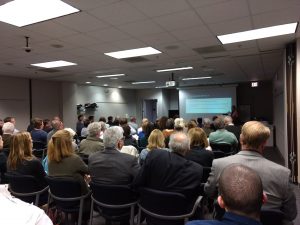
The Virginia Energy Efficiency Council partnered with the Hampton Roads Chamber of Commerce, the Mid-Atlantic PACE Alliance, Sustainable Real Estate Solutions (SRS), Viridiant, and the Virginia PACE Authority (VPA) to host a C-PACE workshop for the Hampton Roads region. This was one of our most attended C-PACE events to date, with over 50 people present. The room consisted of representatives from the Cities of Norfolk and Portsmouth, along with area developers, property owners, contractors, engineers, and architects.
Speakers included Abby Johnson (VPA), City Councilmember Andria McClellan (Norfolk), Jessica Greene (VAEEC), Rob McRaney (Viridiant), and Scott Dicke (SRS). Topics covered included the value proposition of C-PACE for the Hampton Roads region, a history of C-PACE in Virginia, program administration basics, case studies, and action steps to bring C-PACE to the area. The full presentation can be viewed here.
Along with spreading the word about C-PACE, participants were encouraged to contact their local officials to urge the adoption of a C-PACE program. This includes contacting city councilmembers via phone, email, or by submitting letters of support. The VAEEC has created template letters of support that interested property owners, developers, or contractors can use to send to their local officials. Over the course of the past few years, the VAEEC has seen how constituent support and outreach plays a critical role in getting localities to move forward with developing a program.
If you would like to submit a letter to your local officials, the templates can be found below. Contact Jessica Greene (jessica@vaeec.org) with any questions.
2019 General Assembly: passage of two C-PACE bills
Senate Bill 1559 (Sen. Lynwood Lewis) was introduced to amend the current Commercial Property Assessed Clean Energy (C-PACE) statute to add “shoreline resiliency” to the list of projects that can be financed using C-PACE. VAEEC members Abby Johnson of the Virginia PACE Authority and Attorney Bill Nusbaum, along with Cliff Kellogg, drafted proposed amendments to expand the bill’s reach to cover all resiliency improvements as well as stormwater management measures. State staff also contributed language modifying the stormwater management reference by adding “with a preference for natural or nature-based features and living shorelines”. Further amendments also clarified the language around the need for a local government to specify a “maximum aggregate dollar amount” financeable under a C-PACE program in a local ordinance. In the amended version, a cap on total dollars allowed by a program would only be required if public funds were utilized. By contrast, if a C-PACE project were privately financed, then only a total project cap would be needed. The House approved the bill 99-0, and it was signed by the President of the Senate on February 22nd as SB1559ER.
Senate Bill 1400 (Sen. J. Chapman Petersen) was introduced to add stormwater management to the list of projects that could be financed using C-PACE. Initially, this bill also authorized localities to establish Residential Property Assessed Clean Energy (R-PACE) financing; however, this language was stricken from the bill. By February 20th, the bill unanimously passed the House and the Senate to allow for C-PACE financing of stormwater management.
Both bills are now headed to the Governor’s desk for signature, and the new amendments will become effective on July 1, 2019. We hope that by making financing of resiliency and stormwater improvements available, more localities will adopt a C-PACE ordinance, thus making energy saving and renewable energy benefits of C-PACE more broadly available across Virginia.
We are excited to see such progress happening within these past few months and look forward to seeing more C-PACE programs come online across Virginia. For more information about C-PACE, check out our webpage, vaeec.org/PACE.
C-PACE Progress in the Commonwealth
There has been an increase in C-PACE activity and progress across the Commonwealth in the past few months, including several localities taking steps to enact their own program. Learn about these updates and resources by reading below, or by listening to a recording of our September webinar, C-PACE in Virginia: Resources Available to Localities.
Localities Moving Forward
Arlington County: The pipeline of projects is growing, and in a milestone for the program one was recently reviewed with capital providers to determine funding interest.
City of Fredericksburg: Staff is currently drafting a C-PACE ordinance, and a project is already in line to utilize C-PACE once a program is launched.
Fairfax County: In June, the Fairfax County Board of Supervisors Environmental Committee directed staff to write an ordinance. Staff will develop and submit a draft C-PACE ordinance to be considered by the Environmental Committee during their February 2019 meeting.
Loudoun County: Back in January of this year, the Loudoun County Board of Supervisors voted to direct staff to develop a C-PACE program structure, evaluate options for program administration, and draft an ordinance. In July, the Board reconvened and staff recommended the development of a C-PACE ordinance that would utilize a third-party program administrator for services such as billing and collection of loan payments and allow the County to enforce special assessment liens in the case of defaults.
Other localities looking to move forward with developing a C-PACE program include the cities of Alexandria, Charlottesville, Norfolk, and Roanoke, and the counties of Albemarle, Spotsylvania, and Stafford.
Resources Available to Virginia Localities
Several resources have been recently released to assist localities with the development of C-PACE programs, including case studies, model ordinances, program guidelines, and an RFP template.
Model Ordinances:
Arlington County has their Ordinance posted to the Arlington C-PACE website for anyone to view.
Earlier this year, the VAEEC released a Virginia Model Ordinance for localities to use. This document was commissioned following input and review from a wide variety of C-PACE experts and incorporates key factors we consider to be crucial to implementing an effective C-PACE program.
The Virginia PACE Authority, or VPA, used the Virginia Model Ordinance to create an updated and abbreviate Ordinance that localities can use.
Mid-Atlantic PACE Alliance (MAPA) Resources and Regional Toolkit: MAPA has a variety of resources available on their website. This includes fact-sheets, such as What is C-PACE and Frequently Asked Questions. Additionally, there are several case studies highlighting projects in Washington D.C. and Maryland.
As part of its mission to accelerate the development and utilization of C-PACE in the Mid-Atlantic region, MAPA has released a Regional Toolkit. The toolkit provides best practices specific to this region and guidance and resources that streamline efforts to develop and launch a C-PACE program.
RFPs for Program Administration:
A template has been created to help localities craft their Request for Proposals (RFP) for Program Administrator services.
Along with several resources included on their website, Arlington County has the option for Virginia localities to ride their contract with their program administrator, SRS. This step eliminates the need for a locality to go through their own RFP process for a Program Administrator.
To learn more about C-PACE, be sure to check out vaeec.org/pace or contact Jessica Greene at jessica@vaeec.org.
The Mid-Atlantic PACE Alliance, or MAPA, is comprised of state agencies, non-profit institutions, and private businesses working to accelerate the development and utilization of C-PACE in Virginia, Maryland, and DC. As part of their objective to accelerate the development and utilization of C-PACE programs within the tri-state area, MAPA developed a regional toolkit with feedback and input from C-PACE experts across the country.
The toolkit is a resource for stakeholders, including but not limited to local governments, program administrators, building owners, contractors, capital providers, and local lenders, providing best practices specific to this region. For localities, the provided guidance and resources streamline efforts to develop and launch a C-PACE program.
“[The toolkit] includes guidance on program development, financial underwriting, technical project criteria, sample program documents, and a model ordinance developed by the Virginia Energy Efficiency Council (VAEEC). This section also includes information on Arlington County’s C-PACE program, the first active C-PACE program in Virginia which launched in January 2018.”
With C-PACE still relatively new in Virginia, there is still a need for materials that will help stakeholders better understand the benefits of the program. Therefore, along with program guidance for interested localities, the toolkit also includes marketing information and resources. These materials help educate stakeholders in an effort to build support for and to promote C-PACE.
As many of you know, the VAEEC has been carrying out outreach and education to Virginia localities for just shy of two years now. We have encountered countless city and county staff and representatives who have been anticipating the release of this toolkit. With a section completely devoted to setting up a program in Virginia, we believe this toolkit will prove itself to be a vital resource to getting additional C-PACE programs up and running throughout the Commonwealth. We welcome the opportunity to meet with any stakeholder interested in C-PACE.
Contact Jessica Greene (jessica@vaeec.org) if you have any questions, or if you would like to schedule a meeting or call.
Latest Updates on C-PACE in Virginia
The VAEEC has been focused on advancing Commercial Property Assessed Clean Energy, or C-PACE, financing across the Commonwealth for the past few years. Since Virginia’s C-PACE law requires interested localities to develop and implement their own C-PACE program, start up can be on the slow side. However, we’ve seen a lot more traction lately thanks in part to the launch of Virginia’s first C-PACE program (in Arlington County) and the recent release of C-PACE resources for local governments.
Over 30 states and Washington, D.C. have approved C-PACE programs. Virginia joined this growing list in 2009 when it first passed C-PACE enabling legislation, which was later amended in 2015. Our C-PACE law includes all new and existing commercial, industrial, multifamily residential (over four units), and nonprofit buildings.
Arlington County’s C-PACE program officially launched in January of this year with the goal of improving new and existing buildings and helping the County’s Community Energy Plan implementation. Sustainable Real Estate Solutions, or SRS, was selected as their independent, third party program administrator to provide marketing, outreach, education, and quality assurance services.
During a January 2018 Board meeting, the Loudoun County Board of Supervisors unanimously voted to direct staff to develop a C-PACE program structure, evaluate options for Program Administration, and draft an ordinance. These items will be brought back to the Board at a future meeting for consideration. Similarly, Fairfax County is exploring the development of a C-PACE program. County staff are developing information for the Environmental Committee with the goal of presenting their findings to the Committee at their next meeting on June 12th.
In addition to providing educational information to Loudoun and Fairfax, the VAEEC is working with several other jurisdictions to answer questions and help with program development. Just last week, we worked with the City of Virginia Beach to organize a C-PACE informational session for all municipal staff in the Hampton Roads region. Representatives from the Cities of Norfolk, Portsmouth, and Virginia Beach were in attendance. We are also working with local Virginia chapters of the Sierra Club to host a C-PACE event on May 30th in the City ofAlexandria. This event will be open to all C-PACE stakeholders in the area, including property owners, contractors, lenders, and municipal staff. We also continue to work with the City of Charlottesville and Albemarle County to answer staff questions and provide guidance on the resources currently available to localities.
Resources for Local Governments
In early 2018, the VAEEC released a Virginia model ordinance for localities to use when crafting their own program. The ordinance was commissioned following a review and input from a wide variety of C-PACE experts in the lending, local government, engineering, legal, and policy fields. This document incorporated key factors that we consider to be crucial to implementing an effective C-PACE program.
Accelerating C-PACE throughout DC, MD, & VA
As part of its mission to accelerate the development and utilization of C-PACE in the Mid-Atlantic region, MAPA is currently creating program implementation guidance. These regional guidelines will be a part of a toolkit created to help localities craft their own C-PACE program and is slated to be released by June. In conjunction with MAPA, the VAEEC will be hosting a C-PACE webinar in September that will walk attendees through both this toolkit and the Virginia model ordinance.
Virginia localities may review the program infrastructure implemented in Arlington County, including the County ordinance and other program documents. There is also the option to “ride” the C-PACE Program Administration contract with SRS, which would eliminate the need for a Request for Proposals (RFP) process and shortens the time to program launch. Localities may also contract directly with SRS if cooperative procurement is not preferred. Explore the Arlington C-PACE website for more information.
The VAEEC prides itself on being a neutral, trusted resource for any Virginia localities interested in C-PACE. We are actively meeting with local governments across Virginia to discuss all available options and help each locality determine which option best suits their needs. If you would like to know more about C-PACE, contact Jessica Greene at jessica@vaeec.org.
Latest PACE Updates and Fairfax County Lunch + Learn Recap
On November 29, 2017, the Virginia Energy Efficiency Council held our latest Commercial Property Assessed Clean Energy, or PACE, Lunch + Learn for Fairfax County and surrounding areas. With an audience of approximately 70 contractors, developers, property owners, lenders, and government officials, this was our largest PACE Lunch + Learn event to-date. The Great Falls Group of the Virginia Sierra Club co-hosted the event, and sponsors included Petros PACE Finance (event sponsor) and John Marshall Bank- Tysons Corner Region (lunch and networking sponsor).
The following speakers provided attendees with an overview of Commercial PACE, including its status across the Commonwealth, case studies, and its value proposition for the area, as well as the development and status of Arlington County’s PACE program:
Abigail Johnson, President, Abacus Property Solutions and Atlantic PACE
Cliff Kellogg, Vice President of Strategic Initiatives, Petros PACE Finance
Richard Dooley, Community Energy Coordinator, Arlington County
The timing of this event allowed speakers to update guests on the recent PACE advances in the Commonwealth:
On November 18th, the Arlington County Board approved the County’s PACE ordinance, thus making Arlington the first locality in Virginia to offer a PACE program. Sustainable Real Estate Solutions, or SRS, will serve as the County’s program administrator in charge of outreach and education, project underwriting, and quality assurance. The program is expected to launch this month, and the County is holding a PACE training for contractors on December 12th.
In October, Loudoun County’s Finance Committee forwarded a resolution to adopt a PACE program to the full Board for discussion. The Board will be reviewing this resolution at their January 18th meeting.
Virginia Model Ordinance and Regional Guidelines will become available in January 2018.
The VAEEC is working with our partners to create a PACE model ordinance, which will help jurisdictions looking to develop their own PACE program. The ordinance will define the roles of all key parties (program administrator, jurisdiction, property owner, and lender), list qualifying improvements, specify how PACE works, and provide a cooperative procurement rider.
As a part of the Mid-Atlantic PACE Alliance, or MAPA, the VAEEC is working with partners across Virginia, Maryland, and DC to develop regional PACE program guidelines. These guidelines will include: project eligibility standards; the process for a typical PACE project; a suite of template documents; and application requirements. The guidelines will help provide consistency of design, administration, and documents within the Mid-Atlantic region while encouraging standardization and transparency.