Data Center 101
There are over 300 data centers in Virginia right now, with 241 of them concentrated in Northern VA, and new centers are proposed or approved every day. Loudoun County alone has 117 in the pipeline. It’s little wonder why – the Commonwealth boasts over $9 billion in tax revenue from the data center industry alone. As an economic driver, that is completely unmatched. Legislators and other decision-makers rely on that income for local and statewide endeavors.
As an environmental and energy factor? Not so good. IEA forecasts that energy demand will double by 2030. “In the United States, power consumption by data centers is on course to account for almost half of the growth in electricity demand between now and 2030. Driven by AI use, the US economy is set to consume more electricity in 2030 for processing data than for manufacturing all energy-intensive goods combined, including aluminum, steel, cement and chemicals.”
What does that mean for Virginia, though? Data centers have been hailed as economic drivers, scorned for being environmentally damaging, and feared for their effects on the electric grid. The General Assembly has been slow to move on legislation to regulate the industry, leaving it open to runaway growth.
What is a data center?
Great question. The International Energy Conservation Code defines a data center as, “a room or series of rooms that share data center systems (later defined as HVAC systems and equipment used to provide cooling or ventilation), whose primary function is to house equipment for the processing and storage of data and that has a design total information technology equipment (ITE) equipment density exceeding 20 watts per square foot of conditioned area and a total design ITE equipment load greater than 10 kW.”
The Code of Virginia defines a data center as, “a facility whose primary services are the storage, management, and processing of digital data and is used to house (i) computer and network systems, including associated components such as servers, network equipment and appliances, telecommunications, and data storage systems; (ii) systems for monitoring and managing infrastructure performance; (iii) equipment used for the transformation, transmission, distribution, or management of at least one megawatt of capacity of electrical power and cooling, including substations, uninterruptible power supply systems, all electrical plant equipment, and associated air handlers; (iv) Internet-related equipment and services; (v) data communications connections; (vi) environmental controls; (vii) fire protection systems; and (viii) security systems and services.”
And the American Council for an Energy Efficiency Economy (ACEEE) states, “data center is a general term that can refer to a range of facilities housing computer servers and networking equipment with very different power and market characteristics.”
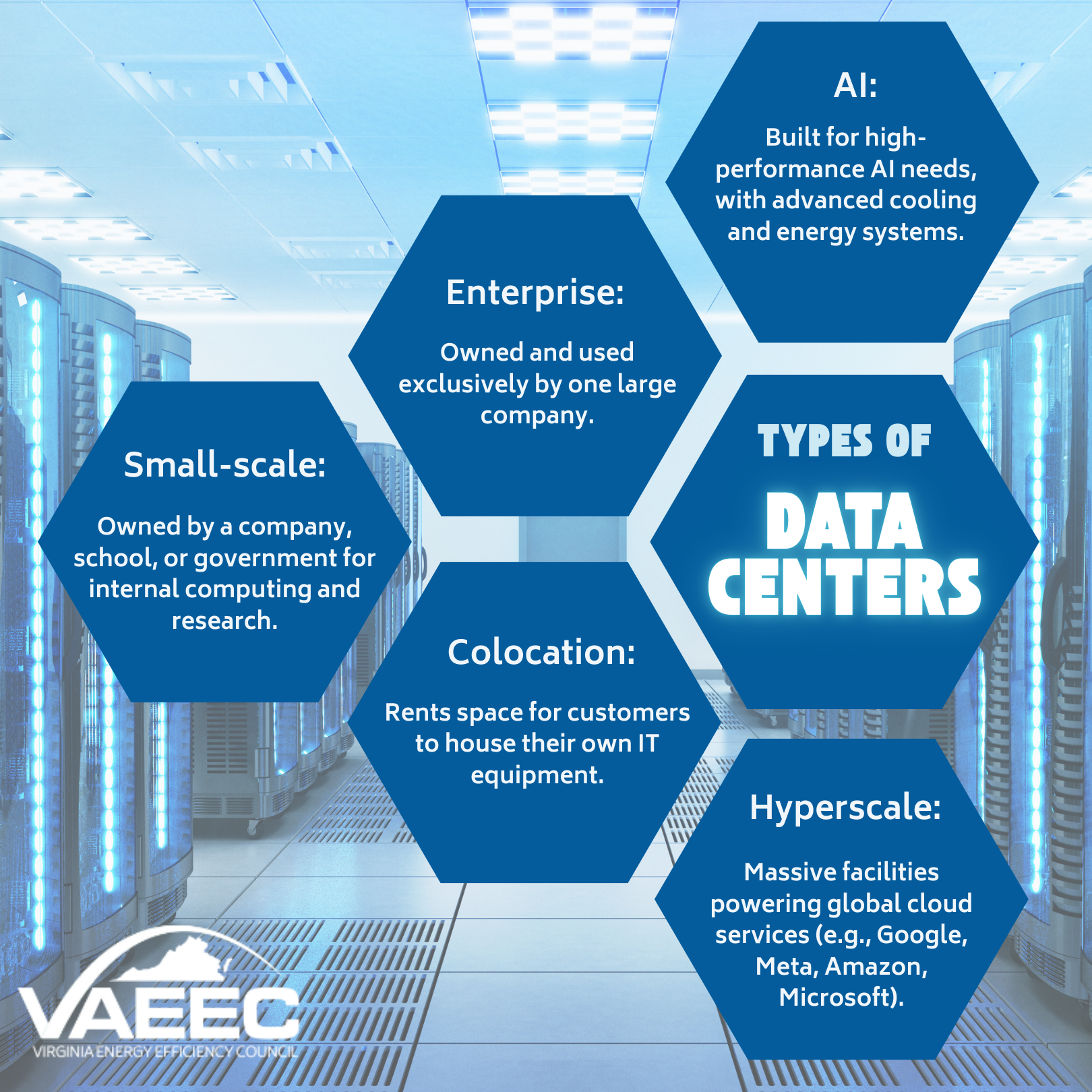
The lack of clarity on what a data center is, makes regulating and legislating the industry incredibly difficult. Moreover, as ACEEE notes, there is no one-size-fits-all definition for the different types of data centers. The server room for the City of Richmond operates very differently than the enterprise scale center for Bank of America, which is itself different from a company like Amazon or Microsoft.
AI and Energy
The AI industry, and by extension crypto, relies on computing equipment that uses exponentially more energy and water than a traditional data center. Vox recently reported that a typical Google search uses .3 watt-hours, while ChatGPT uses over nine times as much energy at 2.9 watt-hours. And while there are strides being made to improve chip efficiency and cooling efficiency, the risk of downtime keeps many of these technologies from widespread use.
There are additional uncertainties tied also to speed of adoption, ongoing legislative and legal battles, and effects on the economy. However, all of the projections and models are based on currently available technologies, which are changing rapidly. AI companies are in a period of explosive growth, but that is not sustainable long term. As technology moves from experimentation to market saturation, standardization will ultimately lower the energy spikes we see now.
There’s also the DeepSeek curveball to consider – by using older models of Graphic Processing Units (GPUs) and an optimized algorithm, the Chinese company released R1, a rival to ChatGPT and other commercial AI products, that uses as little as 10% of the electricity for the same output. This also reduced the cost of operations for DeepSeek, while providing a proof of concept to the industry.
And while AI technology is causing a number of environmental problems – air pollution, overconsumption of electricity, water pollution – it also has the potential to solve some problems, also. A recent article from the Federation of American Scientists said, “Leaders have a real opportunity to leverage AI to maximize positive outcomes—like improving grid efficiency, accelerating clean energy deployment, and optimizing public services—while minimizing harms like overconsumption of energy and water, or reinforcing environmental injustice. Doing so, however, will require new economic and political incentives that align private investment with public benefit.”
Solutions
AI, hyperscale, and cloud computing data centers are heavily incentivized to run as efficiently as possible, as a huge percentage of their overhead costs are from electricity and water use. But as the strain on the grid due to AI increases, some companies are building their own generation systems. Some of these are focused on renewable energy while others rely on fossil fuel generation for energy.
Solutions like demand response, timed cooling, virtual power plants, and other energy efficiency measures can reduce the load without additional generation.
Companies like VAEEC members Siemens, Schneider Electric, and Michael’s Energy have been working with companies for years on cooling, insulation, and automation systems that reduce the up-front load. As up to half of the energy use in a large scale data center is accounted for just by cooling, timed fans, in rack cooling structures, and district heating are just a few of the proven, existing solutions that are available for companies and operators. Utilities and coops are also looking at rate structures and incentives to shift the load on the grid.
The energy efficiency opportunities for data centers can make a significant difference in the amount of energy used in operations. ACEEE released a series of recommendations for states to incentivize data center companies to adopt transparent, energy efficient, and grid interactive practices. Similarly, ASHRAE and Energy STAR have guidelines and standards for more efficient facilities. Though without policy and financial incentives, companies are unlikely to adopt these standards.
Modeling and Projection
According to some estimates, Loudoun’s projected load demand from new data centers could draw 8,190 MW from the grid, on top of the collective 3 GW demand from data centers at large. The potential demand for electricity is daunting, but recent studies may calm the alarm.
As stated above, models and projections on data center energy use are based on currently available technologies in an industry rapidly changing from day to day. The National Labs state that they can confidently project load through 2028 – just two years from now. Factors like electrification, EV adoption, international and economic uncertainty, and an unfettered market make it nearly impossible to predict long-term needs.
Moreover, only a fraction of proposed data centers actually make it into production. Companies regularly buy spots on the interconnection queue for projects that are still in the planning process and may not see approval from the locality or land owner. While utilities and regulatory bodies are starting to account for these proposals, the conversations are still in early stages on how to standardise and streamline processes so that clearer projections can be made.
The Bottom Line
The data center industry is a huge economic driver in Virginia and is here to stay. By utilizing efficient building techniques, investing in energy efficient technologies, and adopting distributed energy resources, companies can manage their load responsibly and project future needs more accurately.
