Award Winners

Award Winners

Recognizing the projects, programs, and organizations advancing energy efficiency across the Commonwealth of Virginia.

2026 VAEEC Innovation AwardRichmond, Virginia

Richmond Fire Station 12 Replacement

Moseley Design · City of Richmond

A 13,000-square-foot replacement for Richmond’s oldest operating fire station, and the City of Richmond’s first LEED Gold certified building.

Richmond Fire Station 12 Replacement

Project Size

13,000 sq ft

Certification

LEED Gold

Location

City of Richmond, Virginia

Award Year

2026

A century of service, reimagined

The City of Richmond Fire Station 12 Replacement demonstrates how a highly utilitarian public safety facility can become a model for resilient, healthy, and high-performance design. The new 13,000-square-foot station replaces, on the same site, Richmond’s oldest fire station still in operation — a facility that served the community for nearly 100 years, dating to the horse-and-carriage era of the fire department.

Located along the Cary Street corridor at the edge of the historic Fan District, Station 12 plays an essential role in providing lifesaving emergency services to Carytown, the Fan, and the surrounding community. The replacement was motivated not only by the limitations of the historic station, but by an opportunity to provide firefighters with a state-of-the-art facility designed around their health, safety, and well-being.

High performance, designed in from the start

From the earliest design phase, an integrative process brought together the City, architects, and engineering disciplines to make energy conservation, carbon reduction, water conservation, and indoor environmental quality fundamental project objectives. Computer modeling informed strategies to reduce both embodied and operational carbon associated with HVAC, lighting, and plug loads.

Energy-saving technologies include a dedicated outdoor air unit with energy recovery, demand-controlled ventilation, high-efficiency heat-recovery VRF, radiant apparatus-bay floor heating, and LED lighting with occupancy controls. These strategies also improve firefighter comfort and indoor air quality through enhanced temperature and humidity control, reduced noise, improved ventilation, and MERV-13 filtration.

Firefighter health at the core

Firefighter health was equally integral to the design. The building incorporates dedicated decontamination spaces, extractor equipment, drying cabinets, turnout gear storage, and carefully planned vertical hot and cold zones that separate contaminated operational areas from living and sleeping spaces — helping reduce firefighters’ exposure to potentially cancer-causing contaminants.

The facility further supports wellness through daylight, views, biophilic design, exercise facilities, and outdoor terraces offering opportunities for respite following stressful shifts. The daylit main stair features a mural of Richmond’s riverscape along the James River, and public art, outdoor gathering spaces, and calming colors and finishes reinforce the biophilic nature of the design.

Verified performance, measured over time

MEP and building-envelope commissioning verify that these high-performance systems operate as intended, while energy and water submetering support long-term performance tracking. The photovoltaic-ready roof provides a pathway for future renewable energy generation.

As the City of Richmond’s first LEED Gold certified building, Fire Station 12 honors a century of public service while demonstrating a new model for municipal facilities.

Why it matters for Virginia

Fire Station 12 provides a replicable model for improving energy performance in public safety and other municipal buildings by demonstrating that energy efficiency can be integrated into the fundamental design of a facility while also improving occupant health, comfort, resilience, and long-term operations.

A key lesson for the sector is that high performance does not depend on a single innovative technology. Instead, Fire Station 12 combines readily applicable strategies — a dedicated outdoor air system with energy recovery, demand-controlled ventilation, high-efficiency heat-recovery VRF, radiant floor heating, and LED lighting with occupancy controls — into a coordinated building system that can be adapted to other fire stations, emergency-response facilities, and municipal buildings with similar operational requirements.

The project also demonstrates how energy efficiency provides benefits beyond energy savings. Demand-controlled ventilation and the dedicated outdoor air system help maintain acceptable CO₂ levels; the VRF system provides improved temperature and humidity control, quieter operation, and greater individual control; and radiant heating improves comfort while reducing energy consumption. These synergies offer a compelling model for public owners seeking to justify efficiency investments based on both operating performance and occupant well-being.

Just as importantly, Fire Station 12 establishes a framework for continuous performance improvement. Energy and water submetering give facility operators tools to understand actual resource consumption, while MEP and building-envelope commissioning help ensure that systems and the enclosure perform as intended. The photovoltaic-ready roof anticipates future renewable-energy investments rather than limiting the facility to technologies available at the time of construction.

Its broader value is as a practical roadmap: use integrative design to identify efficiency opportunities early, select strategies that provide multiple energy and human-health benefits, verify performance through commissioning, measure results through submetering, and prepare buildings for future clean-energy technologies. This approach is transferable across Virginia and can help municipalities move high-performance design from an exceptional project to standard practice.

Integrated Strategies

Strategies working together

  • Dedicated outdoor air unit with energy recovery
  • Demand-controlled ventilation
  • High-efficiency heat-recovery VRF system
  • Radiant apparatus-bay floor heating
  • LED lighting with occupancy controls
  • MERV-13 filtration for indoor air quality
  • Vertical hot and cold zones that separate contaminated areas from living quarters
  • Dedicated decontamination spaces, extractor equipment, and drying cabinets
  • Turnout gear storage
  • MEP and building-envelope commissioning
  • Energy and water submetering
  • Photovoltaic-ready roof
Project Gallery

Inside Station 12

2026 VAEEC Impact AwardLoudoun County, Virginia

Loudoun County Public Schools Boiler Upgrades

Official Project PartnersWashington Gas with CMTA and Loudoun County Public Schools

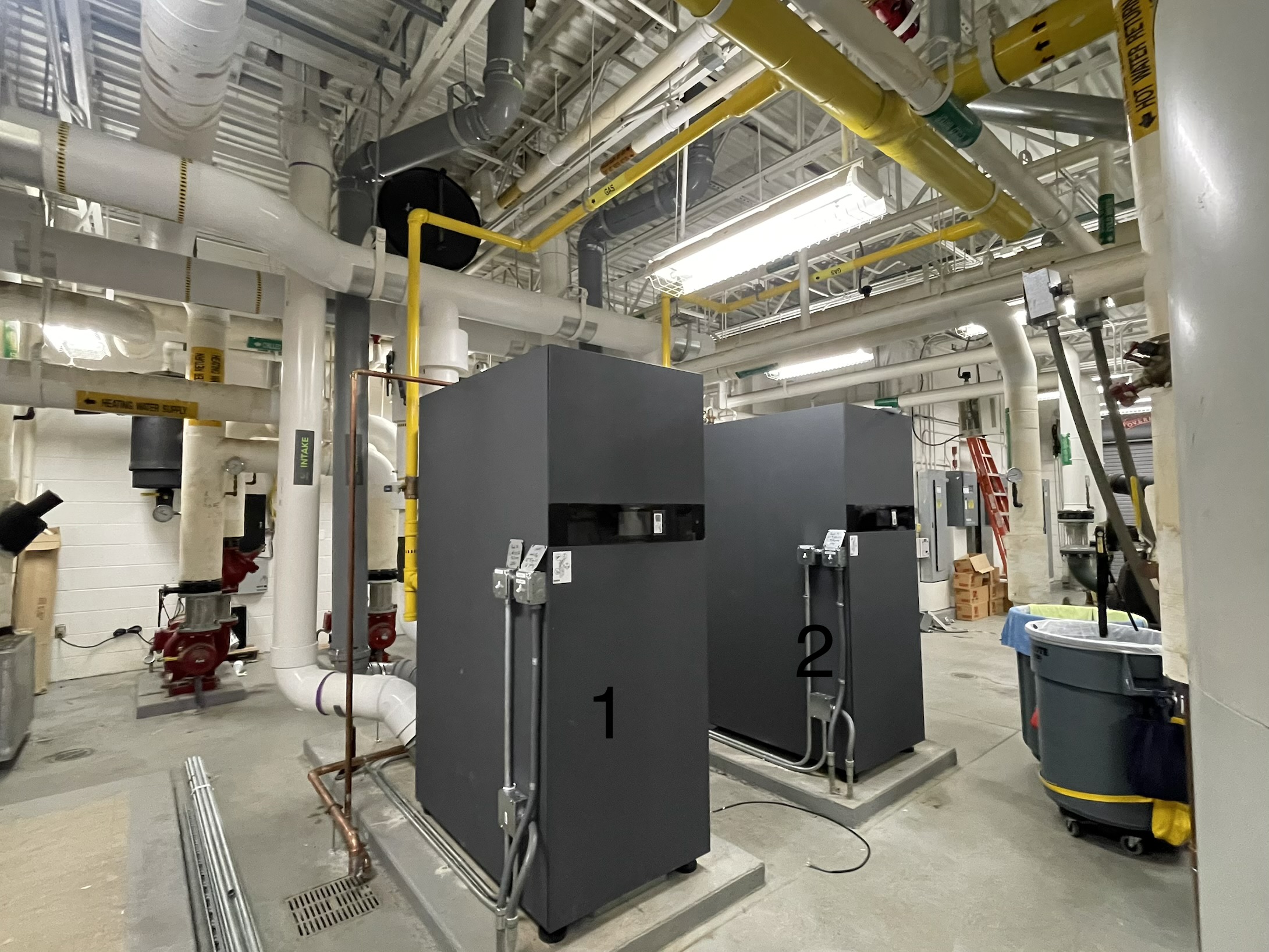
During the summer of 2026, Loudoun County Public Schools partnered with Washington Gas and CMTA to upgrade heating systems across nine schools — replacing aging equipment with high-efficiency condensing boilers and advanced linkageless boiler controls at 24 boilers, saving an estimated 76,516 therms of natural gas annually and earning $345,000 in utility incentives.

Loudoun County Public Schools Boiler Upgrades

Two of the 24 high-efficiency condensing boilers installed across Loudoun County schools (Photo: Vivek Thomas)

Annual Gas Savings

≈76,516 therms

Energy Saved

7.65 billion BTU / yr

Utility Incentives

$345,000

Boilers Replaced

24 across 9 schools

Nine schools, one summer

During the summer of 2026, Loudoun County Public Schools (LCPS) partnered with Washington Gas and CMTA to upgrade heating systems across nine schools, replacing aging equipment with high-efficiency condensing boilers and advanced linkageless boiler controls. The project covered 24 boilers and is expected to save approximately 76,516 therms of natural gas annually, supported by $345,000 in incentives through the Washington Gas Commercial & Industrial Energy Efficiency Program.

Upgrades were completed at Leesburg Elementary School, Smart’s Mill Middle School, Belmont Ridge Middle School, Briar Woods High School, Gum Spring Middle School, Loving Elementary School, Dominion High School, Freedom High School, and Creighton’s Corner Elementary School. Installation work took place during summer break, allowing CMTA to complete construction activities between July and August 2026 with minimal disruption to school operations.

How the technology delivers savings

The project combines high-efficiency boiler technology with linkageless combustion controls, which independently adjust air and fuel inputs to maintain optimal combustion performance. This approach improves heating efficiency, reduces fuel waste, lowers operating costs, and supports more reliable system operation throughout the schools’ facilities.

Together, the 24 boilers are expected to avoid roughly 7,651,600,000 BTU — 7,651.6 MMBTU, or 7.65 billion BTU — of natural gas consumption each year.

Advancing district-wide efficiency goals

LCPS participates in the U.S. Department of Energy’s Better Buildings, Better Plants Program and identified these upgrades as an important step toward achieving its energy efficiency and emissions-reduction goals. By reducing natural gas consumption and improving building performance, the project supports the district’s broader sustainability strategy while providing long-term benefits for students, staff, and taxpayers.

Washington Gas is proud to support LCPS’s commitment to energy efficiency by helping fund these improvements and delivering meaningful energy and cost savings across the district’s school portfolio. Upon full completion, the project will provide lasting operational, financial, and environmental benefits for Loudoun County schools and the communities they serve.

Why it matters for Virginia

The LCPS boiler upgrade project demonstrates how school districts can achieve significant energy savings and emissions reductions by leveraging utility incentives to modernize existing infrastructure. By replacing aging boiler equipment with high-efficiency condensing boilers and linkageless controls across nine schools, LCPS implemented proven, commercially available technologies that can be readily deployed in institutional facilities nationwide.

Rather than pursuing individual upgrades over several years, LCPS took a portfolio-based approach that bundled improvements across multiple schools, maximizing energy savings, streamlining implementation, and capturing available utility funding. The project is expected to save approximately 76,516 therms, or 7.65 billion BTUs, of natural gas annually and received $345,000 in Washington Gas incentives, demonstrating how energy efficiency programs can help overcome capital funding barriers while delivering measurable results.

The project also highlights the value of collaboration between the customer, engineering consultant, installation contractor, and utility program team, with upgrades completed during the summer break to minimize impacts on school operations. This model can be readily replicated by other school districts, universities, local governments, and institutional customers seeking to reduce energy consumption, lower operating costs, improve system performance, and advance sustainability goals through strategic investments in proven energy efficiency technologies.

Integrated Strategies

Strategies working together

  • High-efficiency condensing boilers
  • Linkageless combustion controls
  • Independent air and fuel adjustment for optimal combustion
  • Portfolio-wide bundling of upgrades across nine schools
  • Summer-break installation to avoid disrupting school operations
  • Utility incentives through the Washington Gas C&I Energy Efficiency Program
  • Reduced natural gas consumption and fuel waste
  • Lower operating costs and more reliable system operation
  • Support for DOE Better Buildings, Better Plants goals
Annual Awards

About the VAEEC Awards

The VAEEC Annual Awards recognize outstanding achievement in Virginia's energy efficiency sector through the Innovation Award and the Impact Award.

Annual Awards Program